
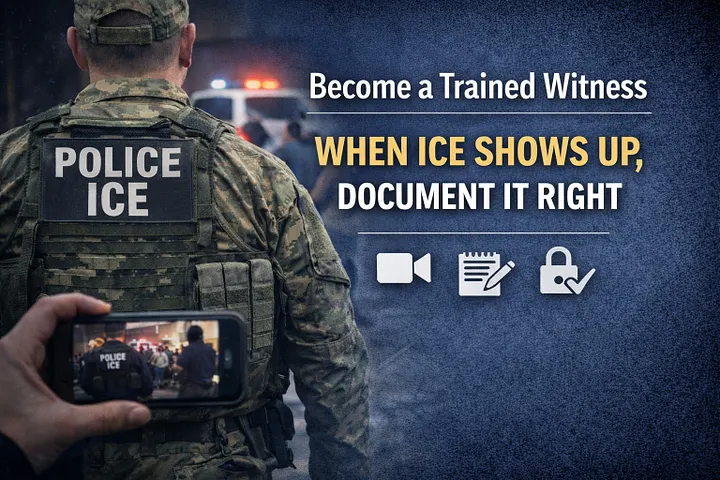
When ICE activity in a community starts to look like intimidation — questionable stops, aggressive tactics, people terrified to leave their homes — the helplessness is real. Marching, mutual aid, and contacting elected officials still matter. They build solidarity, keep pressure on leaders, and remind targeted neighbors they aren’t alone.
But there’s another approach that matters in moments like this: credible witness video and testimony. If you want a street-level role that’s legal, non-violent, and useful, don’t just shoot video — become a trained witness. More impact. More accountability.
PRO TIP: As a trained witness, don’t make your phone and yourself a target. Get a small body cam instead — hands-free, discreet, and more likely to keep recording if things escalate.
Search for “body video cameras” on Amazon — prioritize wide view, night mode, and a time/date stamp.
What trained witnessing is (and isn’t)
Trained witnessing is:
- Observing from a lawful public place
- Recording what you can actually see and hear
- Capturing identifiers and a clean timeline
- Preserving original files and sharing them through trusted channels
Trained witnessing is not:
- Blocking, surrounding, trespassing, interfering, or escalating
- Live-streaming sensitive locations in ways that could endanger someone
- Posting names, addresses, or faces that could put targets at risk
Guidance built for this moment
You don’t have to guess what to film, what not to film, or how to avoid endangering yourself or the people you’re trying to help. These resources will help you document immigration enforcement safely and ethically:
- WITNESS (2025 update): Filming Immigration Enforcement in the U.S. (safety, ethics, storage, sharing, verification)
https://library.witness.org/product/filming-immigration-enforcement/ - WITNESS Media Lab: Eyes on ICE (training materials, tip sheets, examples)
https://lab.witness.org/projects/eyes-on-ice/ - EFF: Yes, You Have the Right to Film ICE
https://www.eff.org/deeplinks/2025/02/yes-you-have-right-film-ice
Add in the discipline of legal observing — how to stay calm, factual, non-interfering, and credible under stress:
- National Lawyers Guild: Legal Observer Program
https://www.nlg.org/massdefenseprogram/los/
The street checklist
Positioning
- Stay in public space.
- Keep distance; respect perimeters.
- Don’t argue, touch, block, or interfere.
Film in this order
- Where/when: street signs, building numbers, landmarks, timestamp
- Who: patches, agency markings, vehicle plates, unit numbers
- What was said: commands, claims about warrants, requests for consent (quote accurately)
- What happened: clean sequence (who did what, when). No guessing.
What to do with what you capture
Step 1 — Preserve it
- Keep the original file unedited.
- Create a short evidence note (text file is fine):
- Date/time + exact location (cross streets if possible)
- Where you were standing
- Start/end time of video(s)
- 5–10 factual lines of what you saw/heard (no guesses)
- Best contact method (if you’re willing)
Step 2 — Report through a national ICE/CBP hotline
Get Lee Phillips’s stories in your inbox
Join Medium for free to get updates from this writer.
United We Dream’s MigraWatch is a nationwide line for reporting ICE/CBP activity and getting guidance:
- Info page: https://unitedwedream.org/our-work/deportation-defense/migrawatch-hotline/
- Call: 1–844–363–1423
- Text: 877877
Use this script:
“I witnessed ICE/CBP activity at [location] at [time/date]. I have video and notes. What’s the safest way to send the video to your team? I can provide a written incident summary and the original file.”
Include in your first message/call:
- Location + time/date
- Number of agents/vehicles
- Visible markings/plates (if safely captured)
- What happened in 2–3 factual lines
- “I have video — tell me how you want it delivered.”
Step 3 — Send it to investigative desks with established tip channels
- Washington Post tips:
https://www.washingtonpost.com/anonymous-news-tips/ - ProPublica tips: https://www.propublica.org/tips/
- The Guardian tips: https://www.theguardian.com/tips
- Guardian SecureDrop: https://www.theguardian.com/securedrop
- New York Times SecureDrop listing: https://securedrop.org/directory/new-york-times/
What to send:
- Your evidence note (tight + factual)
- A representative still image (optional)
- Say explicitly: “I have the original unedited video available.”
Guide to sharing sensitive material with press more safely: https://freedom.press/digisec/guides/source-protection/