
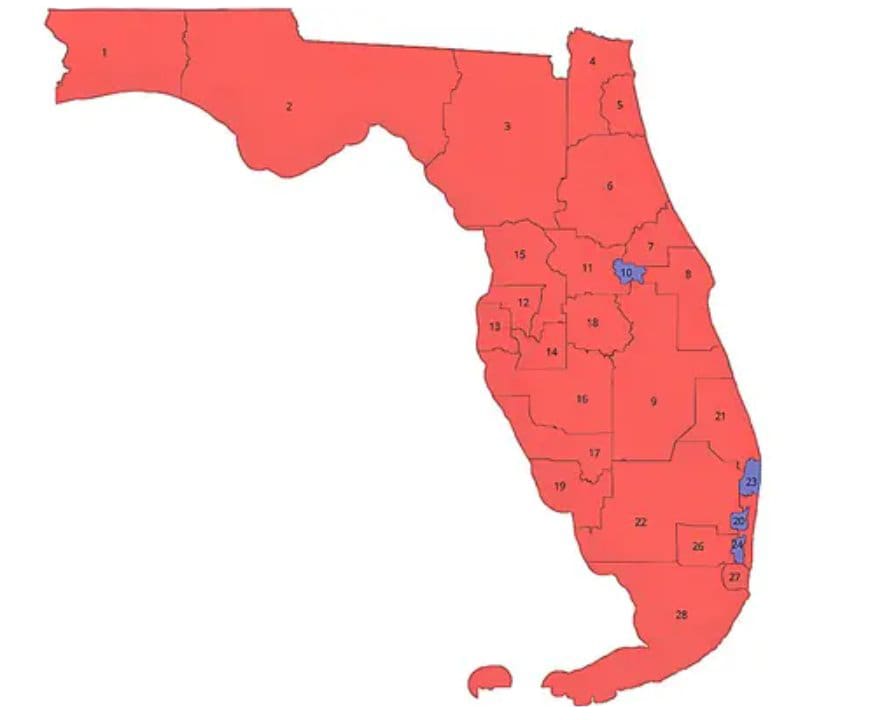
A Leon County Circuit Judge heard arguments that Florida’s new congressional group should be put on hold until after the Midterms.
Attorneys for voting rights groups argued that a clear partisan intent behind the map — which dismantles four Democratic-leaning districts while leaving most seats held by Republicans intact — violates a ban on partisan intent by mapmakers in Florida’s Constitution.
Circuit Judge Joshua Hawkes, an appointee of Gov. Ron DeSantis, said he will issue a decision in writing in coming days. He combined all lawsuits challenging the current map into one case this week, and said he would review all briefs and a transcript of a Friday hearing before making his decision.
Plaintiff attorneys say it’s urgent that a temporary injunction be issued on the cartography. But attorneys for the state say it would be impossible for a judge to extrapolate that the map breaks Florida law just days after DeSantis approved the map.
Of course, that’s the point, according to attorneys who brought the litigation.
“Florida voters will face irreparable harm if the 2026 election goes forward under unlawful districts,” said Simone Leeper, an attorney for the Campaign Legal Center.
Plaintiffs said it was plainly obvious that a new map was drawn to benefit Republicans and hurt Democrats in the Midterm Elections this Fall. That case was largely helped, they said, when Jason Poreda, a senior analyst in DeSantis’ Office and the drawer of the map, admitted in Senate testimony that he used partisan data to craft lines.
“Partisan or electoral performance data was considered, but certainly not at the exclusion of all of the other standards,” Poreda said in a Special Session.
But attorneys defending the state said that’s hardly an admission the maps were drawn purely to obtain gains for House Republicans.
“He responded to a question by stating that partisan data was part of a broader universe of information that was available to him,” said Dan Nordby, an attorney for the Senate, “but he repeatedly denied drawing the map with partisan intent.”
Christina Ford, an attorney for Equal Ground Education Fund, said the degree of partisan analysis didn’t matter.
“It’s plain that Poreda believes that his use of partnership just doesn’t count if it didn’t predominate, but that is not the law,” she said.
Much of the hearing, though, surrounded the timing of any decision. The state’s attorneys argued that established legal principles show the courts should not throw the coming election into chaos by tossing a map and then ordering the state to use the 2022 map instead. The qualifying deadline for federal candidates was already moved to June 12 after DeSantis made 2026 a redistricting year, and candidates will complete pre-qualifying procedures as soon as May 25.
That’s especially concerning, argued administration attorney Mohammad Jazil, considering that a ruling by the Florida Supreme Court decision undermining portions of the Fair Districts amendment in Florida’s Constitution related to race, as well as a recent U.S. Supreme Court ruling about the drawing of majority minority seats. He said a prior configuration of Florida’s 20th Congressional District was arguably unconstitutional.
But attorneys challenging the new map said that’s laughable, especially considering that a Florida Supreme Court decision upheld the map implemented in 2022, and nobody has asserted that the CD 20 makeup specifically violates the constitution. The former map also was designed by DeSantis’ Office and approved in a Special Session, but after a decennial census when a new map was required by law.
Ford said the case should be simply for Hawkes to decide. For now, he only needs to say there’s a likelihood that plaintiffs will prevail in making the argument about partisan intent.
“This case is simple because defendants do not attempt to justify the lines in the districts that they drew,” she said. “This does not end up being a real battle of the facts or the experts, and that makes it easy for the court to decide.”
But Jazil said it’s not clear the partisan intent language can be applied at all. He has argued that part of Florida’s Fair Districts amendment, which also includes a clause forbidding the diminishment of racial minority communities’ voting power, should be ignored.
Hawkes seemed to voice some skepticism about whether that could be concluded at a temporary injunction hearing.
“I’d have to find the partisan intent at the temporary injunction stage, and then, I guess, not only issue the injunction, but strike the whole Fair Districts amendment, all at the temporary injunction stage, by finding it nonseverable,” he said. “It seems like a lot.”
But Hawkes also seemed sympathetic to the argument he not only would have to put the new map on hold, but order the use of a map by Florida officials that they now argue may be unconstitutional.
Plaintiffs say it’s a given that a map that would have been used without passage of new cartography should be the default if the new map goes on hold. Chris Shenton, an attorney for Common Cause Florida, said it only makes sense.
“It has been used in the last two traditional elections,” he said. “It uses updated federal decennial census data, and it survived most legal challenges.”
WHAT CAN I DO ABOUT THIS ISSUE?
- CALL YOUR REPRESENTATIVES and demand they take action.
- USE A TOOL LIKE RESISTBOT OR FIVE CALLS to contact your elected representatives.
- SHARE THIS STORY TO RAISE AWARENESS using the buttons at the bottom of this post, If you can’t see the buttons, turn off your ad-blocker for this site.
- TALK TO FRIENDS AND FAMILY about this issue.
- MAKE A FLYER about this issue to hand out at your next resistance gathering.
- ORGANIZE A MEETUP about this issue at your library, favorite coffee shop, or other venue.
- FIND A LOCAL ORGANIZATION already working on this issue and join forces with them.